Cooling Large Batches of Soup Safely: Shallow Pans, Ice Baths, and Refrigerator Timing
A conservative home-kitchen plan for dividing, chilling, measuring, and storing a large pot of soup without leaving a warm center for hours.
Safety fact check included
CookNest Daily articles surface source counts, timing assumptions, kitchen-test notes, and food-safety caveats. This label means editorial safety review, not a substitute for local food-code or medical guidance.
A full stockpot can stay hot in the middle long after its rim feels cool. That is useful during serving, but hazardous during storage: a deep mass releases heat slowly, and a crowded refrigerator cannot instantly remove it. Safe cooling begins by changing the soup’s shape, volume, and surroundings, not by waiting for the entire pot to reach room temperature.
For a conservative home kitchen, adopt the measurable two-stage benchmark used by the FDA Food Code: cool cooked food from 135°F (57°C) to 70°F (21°C) within two hours, then from 70°F to 41°F (5°C) or below within four additional hours. The total process may not exceed six hours. The 2022 FDA Food Code is a model code for retail and food-service regulators, not a promise that every household setup is safe. Here it provides a conservative planning and verification framework; local rules control commercial production.
Why “let the pot cool” is not a plan
Bacteria grow most rapidly across part of the broad temperature danger zone. USDA tells consumers to keep hot food at 140°F or above, cold food at 40°F or below, and refrigerate perishables within two hours—one hour when ambient temperature is above 90°F (USDA food-safety basics). Those consumer limits and the Food Code stages answer different questions. The two-hour room-temperature rule is a discard boundary for food left out; the two-stage rule describes active cooling performance.
A gallon of soup in a tall pot has little surface area relative to its volume. Heat must travel from the center through many inches of food before refrigerator air can carry it away. Thick chili, chowder, bean soup, and purée move heat more slowly because natural circulation is limited. A tight lid traps heat. One hot stockpot can also warm nearby milk, meat, or ready-to-eat food.
USDA recommends dividing large amounts of leftovers into shallow containers for rapid cooling and says small quantities of hot food can go directly into the refrigerator (USDA leftovers guidance). The choice is not “counter until cold” versus “entire boiling pot in refrigerator.” The practical path is portion promptly, assist cooling, refrigerate in shallow containers, and measure.
Translate the two-stage clock for home use
Start the clock when active cooling begins and soup drops below hot-holding temperature, not whenever someone later remembers it. Record the time and aim to beat both limits with margin.
| Checkpoint | Maximum elapsed time | Required food temperature | Household action |
|---|---|---|---|
| Start | 0:00 | About 135°F | Divide; begin ice bath and/or shallow-pan cooling |
| Stage 1 | 2:00 | 70°F or below | If still above 70°F, discard rather than extend the clock |
| Intermediate | 4:00 | Clearly trending toward 41°F | Rotate pans, stir safely, check refrigerator |
| Final | 6:00 total | 41°F or below | Discard any portion whose measured center is warmer |
| Storage | After cooling | Refrigerator at 40°F or below | Cover, date, and use within 3–4 days |
The second stage permits four hours, not six more hours. The Food Code lists shallow pans, smaller portions, rapid-cooling equipment, stirring in an ice-water bath, heat-conductive containers, adding ice as an ingredient, and loose covering when food is protected from contamination (FDA Food Code).
Use 41°F as the food endpoint and 40°F or below as the refrigerator setting. An appliance thermometer verifies the refrigerator; a clean food thermometer verifies the soup. The refrigerator thermometer guide explains why a control dial is not evidence.
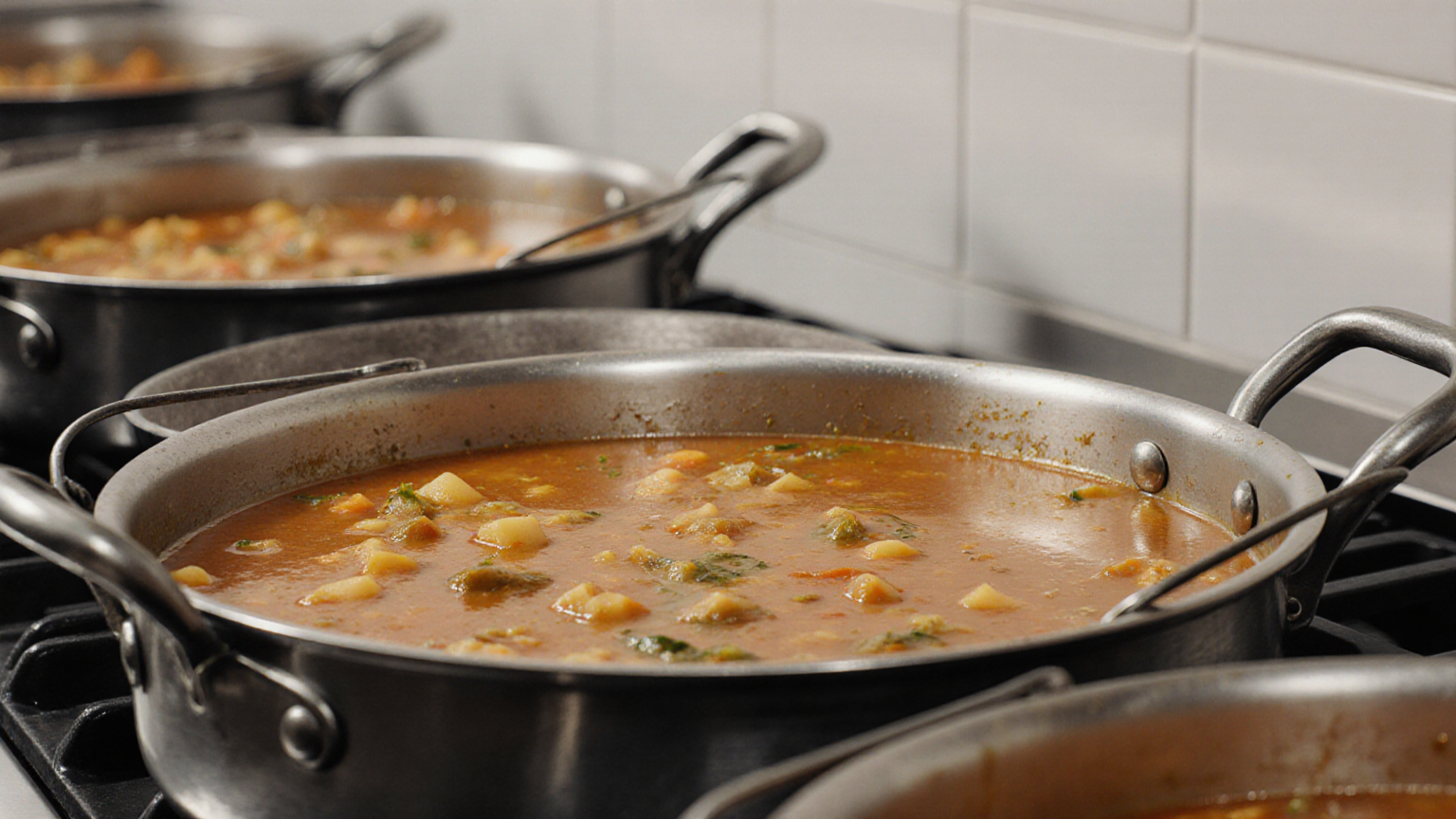
Method 1: shallow pans and small portions
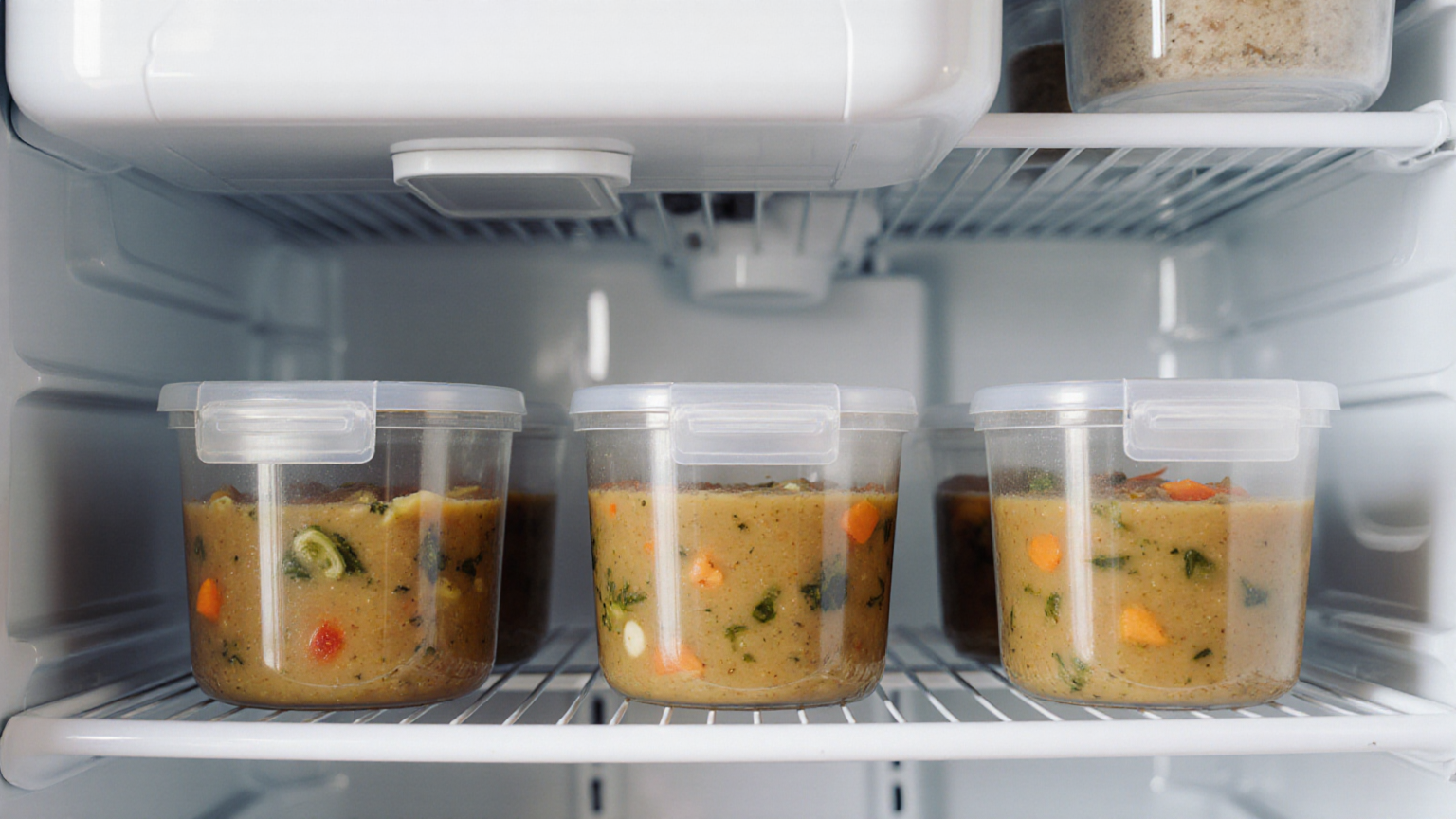
Choose food-grade containers with broad bottoms. Metal usually transfers heat faster than thick plastic or ceramic, but material does not override depth and airflow. Begin around two inches or less as a practical screen, and go shallower for dense chili or purée. This is not a guarantee: pan material, starting temperature, viscosity, refrigerator load, spacing, and stirring change performance. Thermometer readings decide whether the batch met the limit.
Estimate containers before cooking ends. One U.S. gallon is 16 cups. If each pan holds a two-inch layer equal to four cups:
16 cups ÷ 4 cups per pan = 4 pans
If thick soup needs three-cup portions:
16 cups ÷ 3 cups = 5.33, so prepare 6 containers
Never round down when that would deepen the food. Leave stirring space. Arrange containers in one layer with gaps for airflow; never stack warm pans. Keep them away from raw-meat drips.
During rapid cooling, cover loosely or leave uncovered only where protected from splash, dust, hands, and raw food. Cover tightly after reaching 41°F. University of Minnesota Extension likewise advises smaller containers, shallow depth, and an ice-water bath for large quantities (cooling hot food safely).
Method 2: an ice-water bath
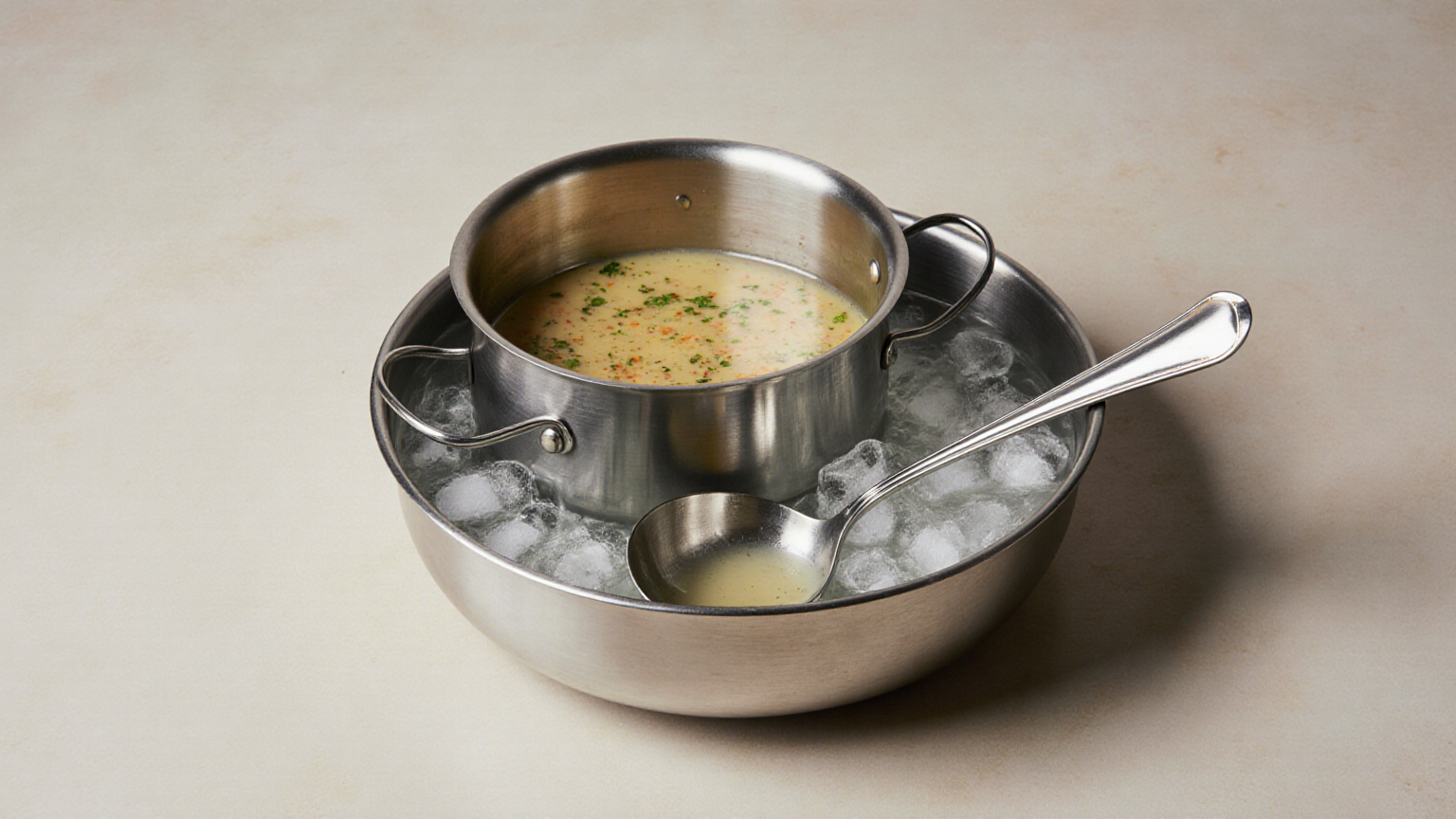
Place the pot—or preferably smaller metal containers—in a stopped sink or larger basin. Add cold water and ice around the outside, keeping the bath below the food-container rim. Sink water must never enter the soup.
Stir soup with a clean utensil while refreshing and moving the ice water. Moving both liquids breaks up insulated warm and cold layers. Divide first: an ice bath around one overloaded stockpot may cool the edge while its center stays warm. Measure the geometric center and another likely warm spot, not the metal wall.
Use a clean, sanitized probe. Stir, insert it into the thick central region, wait for a stable reading, record it, then clean it before another pan. Do not touch the pan bottom, which may create a falsely low result. CDC emphasizes cleaning, separating, cooking, and prompt chilling (CDC four steps).
If the recipe allows dilution, reserve measured recipe water as potable ice. If a soup normally takes 12 cups of stock and four cups of water, cook with stock and enough water for proper cooking, then add the measured four cups as ice. Do not add an arbitrary bag and assume flavor, salt concentration, or safety is unchanged. Clean ice helps remove heat; it does not cancel temperature checks.
Worked cooling log
Consider 12 cups of lentil soup in four metal pans. The cook begins at 6:00 p.m. and checks the slowest-cooling center.
| Time | Elapsed | Warmest reading | Interpretation | Next move |
|---|---|---|---|---|
| 6:00 | 0:00 | 135°F | Clock starts | Ice baths; stir |
| 6:45 | 0:45 | 98°F | Cooling, above stage target | Refresh ice |
| 7:30 | 1:30 | 68°F | Stage 1 passes with margin | Space pans in refrigerator |
| 9:30 | 3:30 | 47°F | Close, but not finished | Rotate and recheck |
| 10:15 | 4:15 | 39°F | Final endpoint passes | Cover and label |
The batch reached 70°F within two hours and 41°F within six. If it read 74°F at 8:00, stage 1 failed; the answer is not “give it four more hours.” If it remained 44°F at midnight, the total limit failed even though the refrigerator felt cold.
A log is better than “cool for 30 minutes,” because kitchens differ. It can reveal an overloaded refrigerator before all containers are committed. The meal-prep temperature routine uses the same time, temperature, and labeling discipline.
Refrigerator timing without warming other food
Before filling the refrigerator, confirm 40°F or below and clear vents. Make space while soup cooks. Do not leave existing perishables on the counter. Put warm shallow containers where air moves around them.
Do not wait for “room temperature.” USDA permits prompt refrigeration of properly divided hot food and warns against leaving perishables out beyond two hours (USDA safe handling). Do not refrigerate one very large, tightly covered stockpot and assume compliance; division changes its thermal behavior.
After verified cooling, label the name and date. USDA generally recommends eating refrigerated cooked leftovers within three to four days. Count cooling day as day one and freeze excess sooner. The freezer labeling plan prevents an undated container from becoming a guess.
Stop conditions: discard, do not rescue
Discard without tasting when:
- soup remains above 70°F after two cooling hours;
- it does not reach 41°F within six total hours;
- it sits at room temperature for two hours, or one hour above 90°F;
- start time, warmest temperature, or refrigeration history is unknown;
- dirty utensils, sink water, raw-food drips, glass, or chemicals contaminate it;
- the refrigerator loses power and safe cold holding cannot be verified;
- someone repeatedly warms and recoils the shared container; or
- only a cool edge was measured while the center went unchecked.
Reboiling is not a dependable rescue. Some hazards involve toxins ordinary reheating may not solve, and an unknown history cannot be reconstructed. Smell, appearance, bubbles, and a small taste cannot prove safety.
During an outage, keep doors closed and use an appliance thermometer. FoodSafety.gov says an unopened refrigerator keeps food cold about four hours and directs consumers to discard refrigerated perishables above 40°F for four hours or more (power-outage chart). CDC explains that foodborne illness can be serious and is not always predictable from appearance (CDC food-safety basics). For batch-cooking logistics outside an outage, use the fast leftovers cooling plan as a companion workflow.
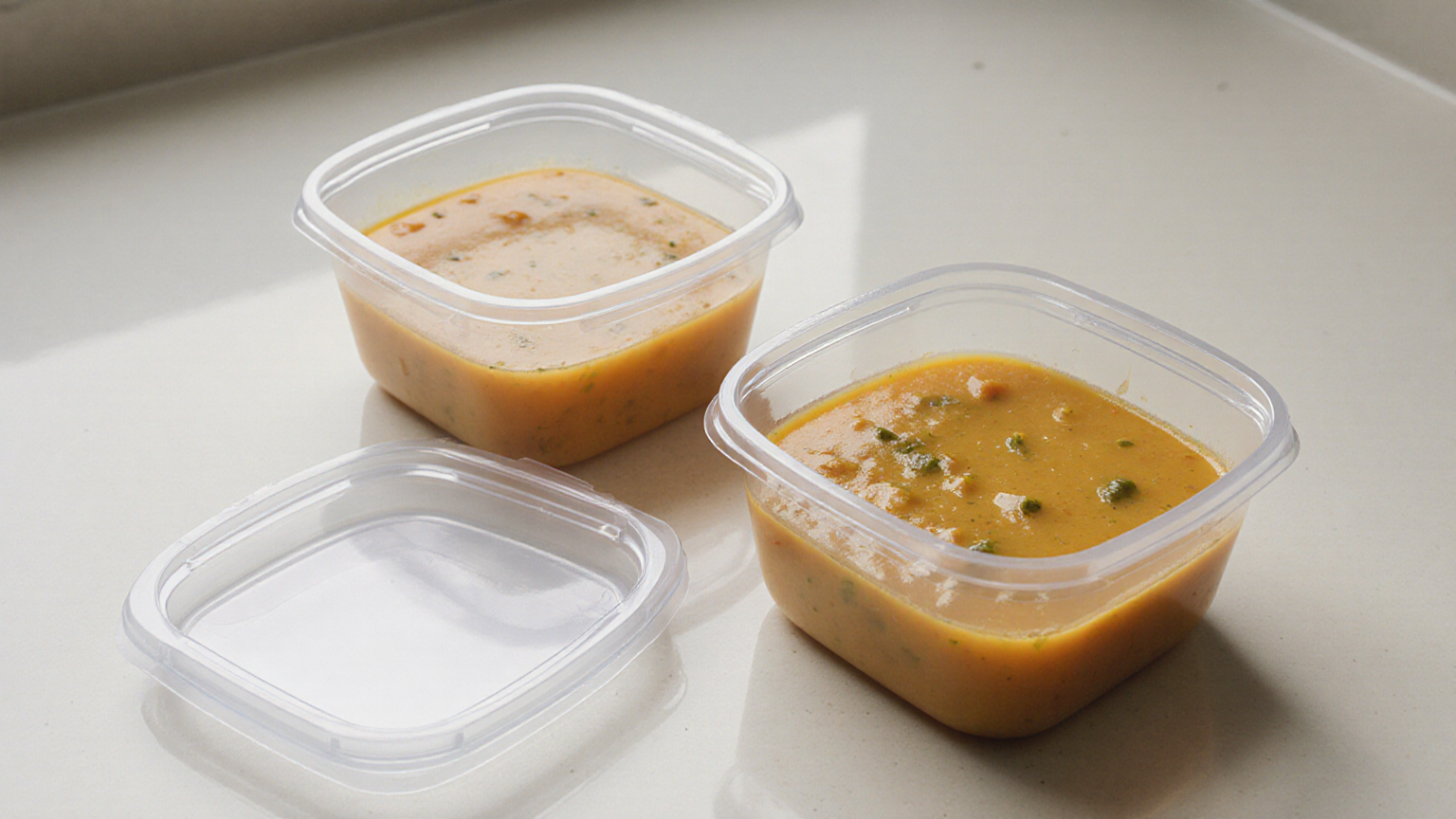
Two-part cooling checklist
Before cooking ends
- Verify the refrigerator is 40°F or below.
- Clear one shelf without blocking vents.
- Prepare enough shallow food-grade containers; never round down.
- Make ice and ready a clean bath for a large or thick batch.
- Check and clean the food thermometer.
- Write the start, two-hour, and six-hour times.
- Keep raw foods below and away from cooling soup.
During and after cooling
- Divide promptly instead of leaving soup in the stockpot.
- Keep depth around two inches or less; go shallower for dense food.
- Stir safely and refresh melted ice.
- Measure the center of the slowest pan.
- Record 70°F by two hours and 41°F by six total hours.
- Cover tightly after cooling, then date and refrigerate or freeze.
- Use refrigerated soup within three to four days.
- Discard whenever a deadline or history is uncertain.
Limitations
This guide addresses cooked soup in a U.S. household. It is not a HACCP plan, process-authority opinion, commercial procedure, canning method, medical recommendation, or local code interpretation. Institutional batches, vacuum packaging, cook-chill systems, and food for sale require approved procedures and regulatory oversight. Acidity, salt, altitude, smell, and appearance do not justify extending the limits.
Adults 65 and older, children under five, pregnant people, and people with weakened immune systems face greater risk from foodborne illness. Use especially strict handling and a low threshold for discarding questionable food. When illness follows a shared meal, contact a healthcare professional and public-health authority; severe symptoms require urgent care.
Frequently asked questions
Can hot soup go directly into the refrigerator?
Yes, after prompt division into small, shallow containers with airflow. Do not put in one deep, tightly covered stockpot. An ice bath can remove heat first, but measured checkpoints still matter.
Must a household follow the FDA Food Code?
The Food Code is a regulatory model. This article uses its stages as a conservative household benchmark. Licensed operations must follow their regulator and approved food-safety procedures.
Is two inches always safe?
No fixed depth guarantees safety. It is a useful starting point for many liquids; thick food may need shallower portions, stirring, conductive containers, or more ice. Center temperature and elapsed time decide.
Can soup be frozen before refrigerator temperature?
Small, rapidly cooling portions may be frozen, but a large hot load can warm neighboring food and cool slowly. Use shallow portions, spacing, cooling assistance, thermometer verification, and the appliance manufacturer’s guidance.
What if the start time was not recorded?
Do not invent a timeline from the current temperature. If reliable evidence cannot establish both cooling stages and room-temperature limits, discard the soup. A fresh batch costs less than gambling on an unknown history.