Homemade Garlic in Oil: Botulism, Refrigeration, and Freezing Safety
A conservative guide to making small batches of garlic in oil for refrigerated or frozen use without treating homemade oil as shelf-stable.
Safety fact check included
CookNest Daily articles surface source counts, timing assumptions, kitchen-test notes, and food-safety caveats. This label means editorial safety review, not a substitute for local food-code or medical guidance.
A jar of garlic submerged in oil looks simple, but it behaves differently from plain garlic or plain oil. Fresh garlic can carry Clostridium botulinum spores from soil. Oil excludes oxygen, while garlic contributes moisture and is naturally low in acid. Given enough time at a permissive temperature, that combination can allow spores to grow and produce botulinum toxin. The safe home strategy is not to judge the jar by smell or appearance. It is to control temperature, time, batch size, and labeling from the moment garlic meets oil.
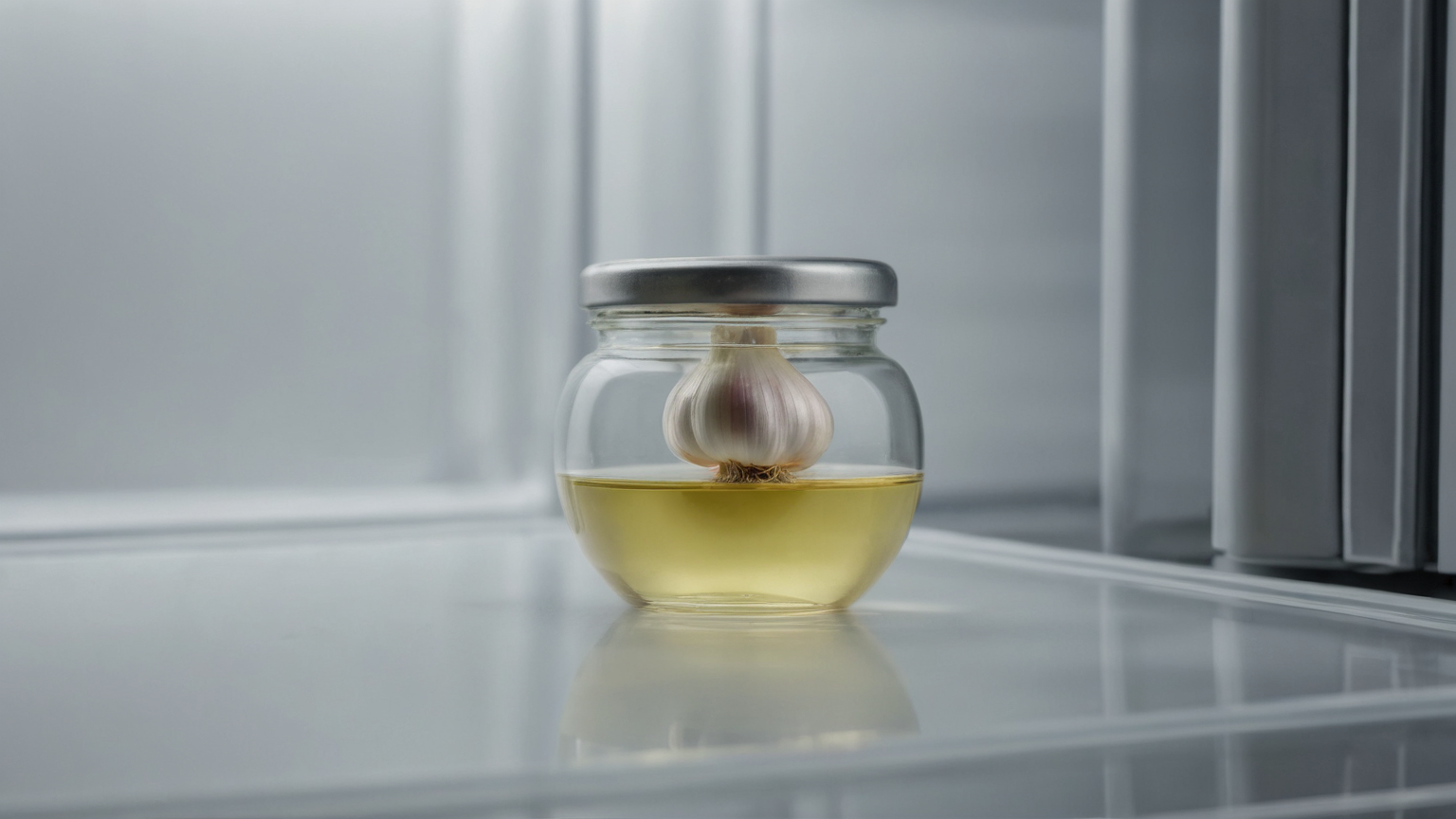
For ordinary, non-acidified homemade garlic in oil, use this conservative rule: refrigerate immediately at 40°F (4°C) or below, use within four days, or freeze promptly in small portions. Never store it at room temperature. This article covers only refrigerator and freezer handling. It does not provide canning or room-temperature preservation instructions.
Why garlic in oil creates a special hazard
Botulism is rare, but its consequences are severe. The toxin attacks nerves and can lead to paralysis, breathing difficulty, and death. The CDC overview of botulism identifies the conditions that can support toxin production: little or no oxygen, low acid, enough water, a suitable temperature, and insufficient salt or sugar. Garlic covered by oil can supply several of those conditions at once.
Oil does not “seal in freshness” in a safety sense. It creates a reduced-oxygen environment. Washing garlic does not reliably remove bacterial spores, and adding a pinch of salt, a splash of lemon juice, or a few chile flakes does not turn an improvised recipe into a validated preservation process. Heating garlic until it tastes mellow is also not proof that the final jar is shelf-stable. The FDA’s technical profile of C. botulinum explains why control depends on the organism, food environment, processing, and storage rather than on a sensory cue (FDA Bad Bug Book).
Commercial garlic oils are a separate category. Manufacturers may use measured acidification, controlled processing, preservatives, and packaging validated for a specific product. A store-bought bottle labeled shelf-stable is not evidence that fresh garlic dropped into oil at home can sit beside the stove. Follow the commercial product’s label after opening; follow the four-day cold-storage rule for an ordinary homemade mixture.
The conservative four-day rule—and the seven-day conflict
Two official recommendations appear to conflict. The USDA’s older Complete Guide to Home Canning states that garlic in oil may be kept at 40°F or below for no more than seven days, or frozen for several months (USDA Complete Guide). Current National Center for Home Food Preservation guidance gives a shorter limit: refrigerate garlic in oil at 40°F or below for no more than four days, then freeze for longer storage (NCHFP garlic guidance). The CDC likewise tells consumers to refrigerate homemade oils made with garlic or herbs and throw them away after four days (CDC prevention guidance).
CookNestDaily chooses four days. When credible guidance supplies different maximums for the same high-consequence hazard, the shorter current limit is the clearer household rule. Four days is a maximum under continuous, verified refrigeration—not a target to extend, and not permission to add four refrigerated days after the jar already sat warm. Count the preparation date as day one. If you make the mixture Monday, use or freeze it by Thursday; do not wait until Friday night to decide.
Oregon State University Extension also directs home cooks to refrigerate ordinary flavored oils for up to four days or freeze them for longer storage (OSU Extension). Michigan State University Extension pairs that four-day limit with a two-hour room-temperature discard boundary (MSU Extension). These sources support one short refrigerated window without a counter-storage loophole.
Temperature-and-time decision table
Use actual elapsed time and the warmest known storage condition. Returning a cold-looking jar to the refrigerator does not erase earlier time on the counter, in a warm car, or in an unverified cooler.
| Situation | Time and temperature evidence | Decision | Why |
|---|---|---|---|
| Just prepared | Moved promptly to a refrigerator verified at 40°F (4°C) or below | Refrigerate, label, and use within four days, counting today as day one | This follows the shorter NCHFP and CDC limit |
| More made than can be used in four days | Mixture is freshly prepared and continuously cold | Freeze immediately in small portions | Freezing stops growth while the product remains frozen and avoids stretching the refrigerator clock |
| On the counter during prep or serving | Less than 2 hours total at ordinary room temperature | Return promptly to refrigeration only if still within the four-day calendar window; use soon | Two hours is an outer boundary, not a routine holding plan |
| On a counter, table, or in a warm car | 2 hours or more, or 1 hour or more above 90°F (32°C) | Discard without tasting | Perishable-food time limits become the discard boundary; MSU specifically says discard garlic in oil after two hours at room temperature |
| Refrigerator above 40°F (4°C) | Time above 40°F is known and remains within the applicable short limit | Apply the strictest official rule; when uncertain, discard | An appliance dial is not temperature evidence |
| Refrigerator temperature or elapsed time is unknown | No reliable thermometer reading, label, or timeline | Discard | Safety cannot be reconstructed from smell, bubbles, color, or taste |
| Refrigerated for more than four days | Even if it looks and smells normal | Discard | The chosen four-day maximum has passed |
| Frozen continuously at 0°F (-18°C) or below | Portions remained fully frozen | Keep frozen; thaw only the amount needed | Continuous freezing controls growth, although quality may gradually decline |
| Power outage or partially thawed portion | Time above safe cold temperature is uncertain | Discard | Refreezing does not reverse possible toxin formation during unsafe warming |
The FoodSafety.gov cold-storage chart explains the broader principle: refrigerator limits help keep food from becoming unsafe, while freezer times at 0°F (-18°C) are generally quality limits for continuously frozen food (FoodSafety.gov). Garlic in oil still needs its more specific four-day refrigerator rule.
A refrigerator workflow that leaves no mystery jars
Start with a batch sized for one or two meals, not a decorative bottle. Use clean hands, clean utensils, a clean food-grade container, sound garlic, and fresh oil. Sanitation reduces contamination, but it does not replace cold storage. If garlic preparation has shared a board or knife with raw meat, stop and clean correctly; the site’s cutting-board sanitizing routine provides a separate cross-contamination workflow.
As soon as garlic and oil are combined, transfer the mixture to the refrigerator. Put it on an interior shelf rather than the door, where temperatures fluctuate. Verify the appliance with a refrigerator thermometer instead of trusting its control dial; see the refrigerator thermometer and cold-storage guide for placement and checking habits.
Label the container with three facts: “garlic in oil,” the preparation date, and “use or freeze by” the fourth day. A batch made on August 27 should say “use or freeze by August 30.” A label is more dependable than remembering whether the jar was made before or after the weekend. Keep a clean utensil dedicated to serving. Do not dip bread, fingers, or a utensil that touched raw food into the storage container.
Take out only the portion needed, then return the main container to refrigeration promptly. Do not leave the jar near a burner while cooking. Warm oil may become fluid quickly, but that texture change says nothing about microbial safety. Penn State Extension describes fresh garlic and herbs as low-acid ingredients whose moisture and oxygen-free oil environment create the concern (Penn State Extension).
Freezing is the practical longer-storage option
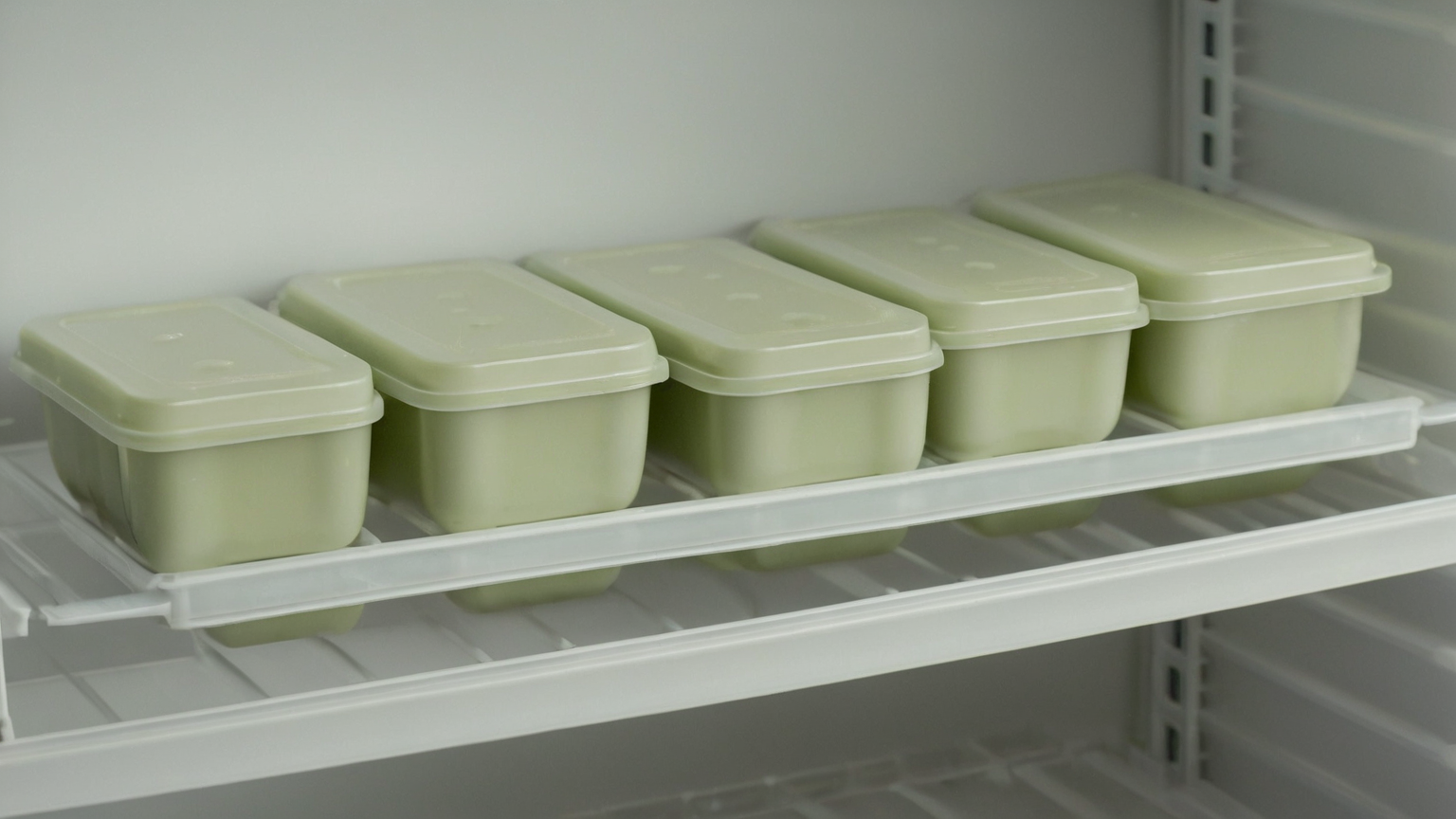
If four days will not be enough, freeze the mixture while it is still fresh—ideally on preparation day. Portion it into a clean freezer tray or several small freezer-safe containers so one serving can be removed without thawing the whole batch. Leave appropriate expansion space in rigid containers, cover tightly, and label the food and freeze date. After tray portions become solid, transfer them with clean hands to a sealed freezer container so garlic odor does not travel through the freezer.
OSU Extension specifically recommends airtight small jars or plastic containers for frozen flavored oils and notes that crushed herbs or vegetables in oil can be frozen in cubes for seasoning (OSU Extension). The freezer inventory and labeling plan can keep those small portions visible instead of lost under larger packages.
Freeze in useful cooking amounts. A tablespoon-sized portion can go directly into a pan, soup, or sauce that will be cooked. If a portion must thaw, thaw it in the refrigerator—not on the counter—and use it promptly. Do not thaw the complete container, scoop from it over several days, and repeatedly refreeze the remainder. That workflow creates a time-temperature history nobody can confidently track.
Freezing is a pause, not a sterilization step. It does not make an unsafe jar safe, destroy every spore, or remove toxin that may already have formed. Never freeze a batch to rescue it after the refrigerator deadline, prolonged counter holding, or an unknown outage. The University of Maine Extension emphasizes that moisture-bearing fresh ingredients in an oxygen-free oil environment require specific safety control and separates home guidance from validated commercial production (University of Maine Extension).
When to discard immediately
Discard homemade garlic in oil without tasting when any of these conditions applies:
- it spent two hours or more at ordinary room temperature, or one hour or more above 90°F (32°C);
- it has been refrigerated longer than four days;
- the preparation date is missing or disputed;
- the refrigerator was above 40°F (4°C) and the duration cannot be verified;
- it warmed during an outage, trip, picnic, or delivery and the timeline is unknown;
- a frozen portion thawed outside controlled refrigeration and its history is unclear;
- someone topped up an old container with fresh garlic or oil, mixing two storage clocks;
- the container is leaking, swollen, cracked, or contaminated; or
- anyone already ate it and has symptoms compatible with botulism.
Cloudiness, sediment, solidified olive oil, or color change may have harmless explanations, but none proves safety. Conversely, a clear, fragrant jar can still be unsafe. CDC warns that botulinum toxin cannot be seen, smelled, or tasted and that even a small taste can be deadly (CDC prevention guidance). Do not taste a questionable batch, feed it to a pet, or try to “cook it safe” as a rescue strategy. Bag or contain it so nobody retrieves it, then discard it according to local waste guidance.
What this guide deliberately does not teach
This is not a canning guide and does not give an acidification formula, pH target, processing schedule, or shelf-stable recipe. Home acidification research applies only to specified ingredients, proportions, particle preparation, acids, and procedures. A casual substitution—different garlic pieces, another acid, extra water, or an unmeasured ratio—can invalidate the safety basis. Penn State summarizes tested infused-oil research, but its existence is not permission to improvise (Penn State Extension).
For the refrigerator/freezer method here, do not attempt to extend life with lemon juice, vinegar, salt, heating, roasting, straining, vacuum sealing, or a decorative wax cap. Straining out visible garlic does not erase the time during which garlic and oil were together. Dried ingredients also require source-specific guidance; “feels dry” is not a laboratory moisture measurement. If the goal is a room-temperature gift or pantry product, buy a properly labeled commercial product rather than adapting this household method.
If someone may have botulism, treat it as an emergency
Foodborne botulism may begin with double or blurred vision, drooping eyelids, slurred speech, trouble swallowing, dry mouth, or muscle weakness. Difficulty breathing can follow. Some people also have nausea, vomiting, stomach pain, or diarrhea, but the absence of digestive symptoms does not rule botulism out. CDC classifies every form of botulism as a medical emergency because treatment must not wait for paralysis to progress (CDC).
Call emergency services immediately if these neurologic or breathing symptoms occur after possible exposure. Do not wait for a routine appointment, do not drive a person who is having trouble seeing, swallowing, or breathing, and do not attempt home treatment. Tell clinicians about the homemade garlic in oil, when it was eaten, who else ate it, and whether any container remains. Follow public-health instructions for preserving or disposing of the food; do not open or sample it again.
A one-minute plan before garlic meets oil
- Confirm the refrigerator is at 40°F (4°C) or below.
- Decide how much the household can use within four days.
- Set out a clean refrigerator container and freezer portions for the excess.
- Write the preparation and four-day use-or-freeze dates before the container becomes oily.
- Refrigerate the working batch immediately and freeze excess promptly.
- Serve with a clean utensil and return the container to cold storage.
- Discard at the deadline or whenever the time-temperature history is uncertain.
This plan fits beside a broader meal-prep food-safety temperature routine. Its value is not complexity; it removes the guesses that make garlic oil risky: “Was that four or five days ago?”, “How warm is this refrigerator?”, and “Can I tell by smelling it?”
FAQ
How long can homemade garlic in oil stay refrigerated?
Use it within four days at 40°F (4°C) or below, with preparation day counted as day one. Although an older USDA guide gives seven days, current NCHFP and CDC guidance gives four. This article chooses the shorter limit and recommends freezing portions before that deadline.
Is two hours on the counter safe if I refrigerate it afterward?
Less than two hours at ordinary room temperature is an outer handling limit, not a recommended infusion period. Refrigerate immediately after preparation. At two hours, discard; above 90°F (32°C), use a one-hour limit. If timing is uncertain, discard.
Does roasted or cooked garlic remove the botulism concern?
No. Home cooking can change flavor and reduce some microorganisms, but it does not by itself validate the finished oil for room-temperature storage. Keep homemade garlic oil refrigerated for no more than four days or freeze it promptly.
Can I make the jar safe by adding vinegar or lemon juice?
Not by improvisation. Safe acidification depends on a tested process with exact ingredients and measurements. This guide intentionally provides no shelf-stable or canning process. For the simple method described here, keep the mixture cold and use the four-day rule.
How long does garlic in oil last in the freezer?
When continuously frozen at 0°F (-18°C) or below, safety is controlled by the frozen state, while flavor and aroma will eventually decline. Make small, airtight portions and rotate them for quality rather than repeatedly thawing one large container. Discard any batch that was unsafe before freezing.
Can I use smell, bubbles, or oil clarity as a safety test?
No. Botulinum toxin may be present without a warning smell, taste, or appearance. Bubbles or swelling are reasons to discard, but their absence does not prove safety. Never taste questionable oil.
What is the simplest safe rule?
Make a small batch, refrigerate it immediately at 40°F (4°C) or below, use or freeze it within four days, and discard it whenever the date or temperature history is uncertain.